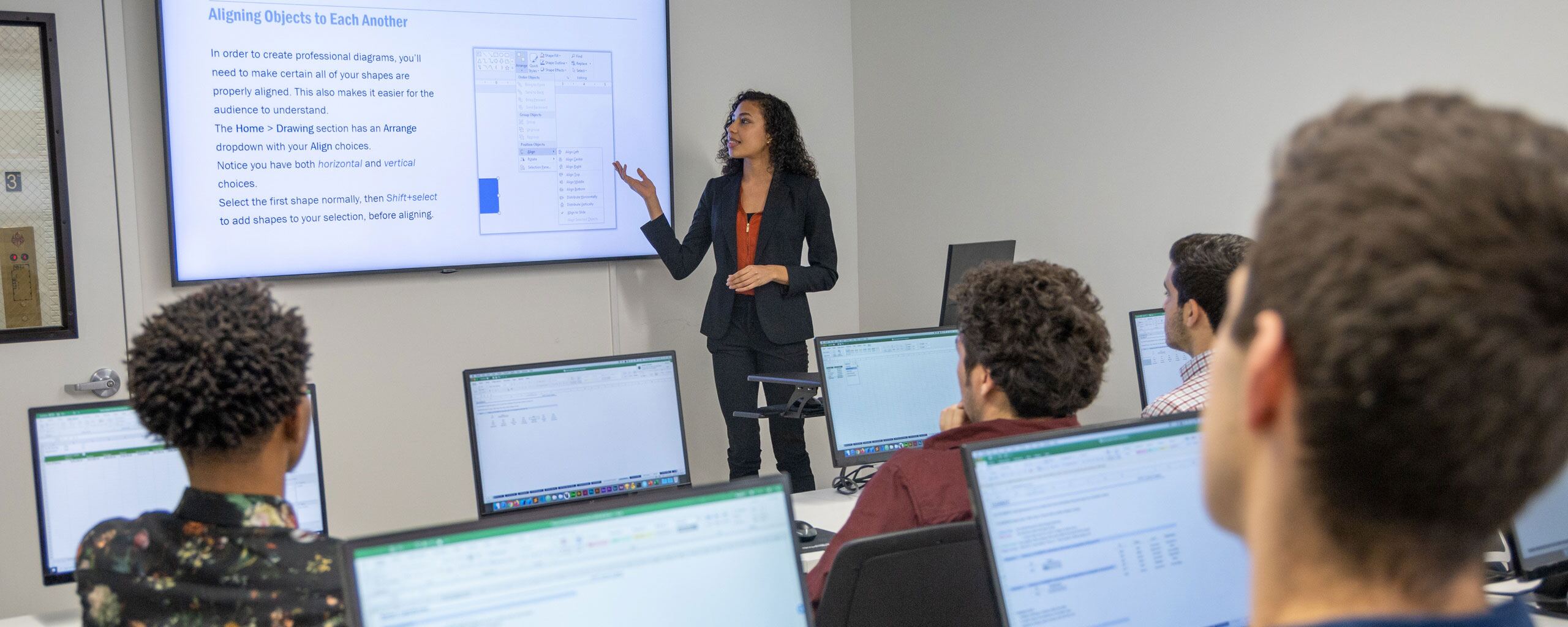
Learn More About Python Classes in San Francisco
Python is a free, open-source, object-oriented programming language developed in 1991 by Guido van Rossum. It is easy to learn and read because of its simple yet powerful syntax. Python has an array of uses, from developing software and websites to automating tasks, analyzing, and visualizing data.
Python is often used in web development to create the back-end of an app or website. Because of its modular nature, Python is especially helpful for scripting or creating code that can be used to automate tasks that must be executed repeatedly. Python has several powerful libraries for data science and analytics. These free libraries are considered to be some of the most robust available for coding.
People who want to change careers to become a Web Developer or Data Scientist often learn Python first before other coding languages. Python is used in many different applications, such as web development, data analysis, artificial intelligence, and machine learning, so many people choose to learn it first.
What Can You Do with Python Training?
Web Developers, Software Engineers, Full-Stack Engineers, DevOps Engineers, Python Developers, and Data Analysts use Python and its libraries for many daily tasks. The Beautiful Soup library is a powerful tool for scraping and mining data from APIs and the internet. NumPy and Pandas are used for data processing and modeling, and Matplotlib creates data visualizations. People with Python skills use it to analyze different types of complex datasets and structures.
What Will I Learn in a Python Class?
When you sign up for a Python class, you will learn foundational programming concepts, like loops, functions, and objects, and how to handle different types of data. The course will also cover how to use conditional statements and object-oriented programming. You will also learn about the many useful Python libraries, like NumPy, Pandas, Matplotlib, and scikit-learn.
Python Fundamentals
In a Python class, you will learn data basics. Types of data include statements and expressions, variables, integers and floats, and strings. Some data structures covered in a class include functions and methods, lists, indexing and slicing, and Booleans.
Structuring Programs
A course will teach you how to structure programs. This includes complex data structures and control flow topics like dictionaries, conditional statements, for loops, and creating functions.
You will also learn about packages and object-oriented programming, including classes and objects, modules and imports, and packages and documentation.
Arrays and Dataframes
A Python course will also cover arrays, a linear data structure with sequentially arranged elements. NumPy, or Numerical Python, is a Python library coders use to work with arrays. Pandas stands for Python Data Analysis Library and is for working with datasets. Pandas can analyze, clean, explore, and manipulate data.
Analyzing and Visualizing Data
Two other skills covered in a Python programming class are data analysis and data visualization. Courses teach you how to filter and clean data, group by operations, and create pivot tables. Once you have analyzed the data, you will learn to create visualizations like bar charts, scatter plots, and histograms using Matplotlib to identify and highlight trends and patterns.
How Hard Is It to Learn Python?
Python is considered one of the best starter languages for novice programmers. The straightforward syntax and versatility of Python make it a top choice for people who are learning to code. However, that doesn’t mean that it isn’t challenging. If you have prior experience with coding, you will have an easier time learning Python. Some of the biggest challenges to learning Python include grasping the concept of object-oriented programming, knowing what Python is used for, and recognizing problems that need to be solved. A class can help you overcome these challenges.
How Long Does It Take to Learn Python?
As with difficulty, the length of time it takes to learn Python depends on prior experience and the amount of time you can spend practicing. Most students become proficient in two to six months. It also depends on what you plan to do with your Python training. If you are learning Python to switch to a career as a Data Scientist, you may go for a deeper level of training than if you want to use Python for website development.
What Should I Learn Alongside Python?
What to learn alongside Python depends on what you plan to do with the language after training. If you are interested in web development, you will want to learn other coding languages like HTML, CSS, JavaScript, or Java. If you plan to change to a career in data science, learning about some of the other Python libraries, like TensorFlow and SciPy, is a good choice, as is exploring data visualization tools like Tableau and Power BI. Signing up for a certificate program in data science can give you the skills to work with artificial intelligence or machine learning.
San Francisco Fields and Industries That Use Python
Any industry that performs data analysis can use people with Python skills, but the web development, data analysis, machine learning, and finance industries use Python the most.
Technology
The tech industry is most notable in San Francisco and has a large presence across most other San Francisco-based industries. Between major companies and AI startups, plus research institutes and corporate labs, Python professionals find work easily in this region. Python is used for machine learning and artificial intelligence applications to allow computers to make decisions or predictions that they have not been specifically programmed to make. Some Bay Area machine learning firms include Forge, TrueML, Snap, Tempus AI, Grammarly, PagerDuty, Cruise, NextRoll, Liftoff, and Redflag AI.
Web Development
The web development industry builds websites and mobile applications for clients. Some web development companies in San Francisco include Innowise, Yellow, Bloorsoft, Three29, and Moonstone Interactive. Many of these firms focus on serving local startups and venture-backed companies in Silicon Valley, creating websites, apps, and platforms that handle a large amount of traffic and integrate with cloud infrastructure. Python is the most widely used language for back-end development, APIs, and automation, so this field requires its professionals to be proficient in the language.
Data Analysis
San Francisco-based companies work with large amounts of data all the time, including everything from tech and healthcare to retail and finance. Consumer behavior, stock market reporting, and company productivity can all be better understood through data analysis. The data analysis industry uses many coding languages, including Python, to work with large datasets for making business decisions. These are some of the top data analysis firms in San Francisco: DISQO, Asana, Doximity, Tempus AI, West Monroe, Ascend.io, VidMob, ZS, Hex, and John Deere.
Finance
The finance industry was one of the first to embrace technology like Python object-oriented programming. Some of the finance companies in San Francisco using Python include Square, Toast, Human Interest, CAIS, SoFi, Navan, Upgrade, and Cedar. Python is heavily used for algorithmic trading, financial modeling, risk assessment, and automation. San Francisco has a particularly strong FinTech ecosystem, and many companies hire Python professionals to manage the high volume of data and integrate with cloud services, as well as implement secure security measures.
Python Job Titles and Salaries in San Francisco
Tech careers in general are well paid and in great demand, especially coding careers. Some job titles for people with Python skills include Web Developer, Full Stack Developer, Software Engineer, Machine Learning Engineer, and Cybersecurity Analyst.
Web Developer
Web Developers use programming languages like Python to create websites and mobile applications. They integrate graphics, audio, and videos into products and build and test prototypes. The U.S. Bureau of Labor Statistics reports an expected job growth rate of 16% for this field over the next ten years and a median annual salary of $92,000. Web Developers in San Francisco earn about $108,000 a year.
Software Engineer
Software Engineers also work with programming languages. Instead of creating website apps, Software Engineers develop many types of products from operating systems to gaming applications. In California, the yearly salary for Software Engineers is $150,000.
Full Stack Developer
Full Stack Developers go beyond website development and work on the entire software stack, including both front-end and back-end operations. Full Stack Developers in San Francisco make around $150,000 annually.
Data Scientist
Data Scientists use Python and other programming languages to collect, clean, analyze, and visualize data. They also write algorithms and create machine learning models. Data Scientists in the U.S. earn a yearly salary of $108,000 and $158,000 in San Francisco.
Cybersecurity Analyst
Cybersecurity Analysts implement and monitor security protocols for companies and government agencies. They check for vulnerabilities in systems, educate network users, and recommend security enhancements. The median yearly salary for a Cybersecurity Analyst in the U.S. is $120,000, and $171,000 in San Francisco.
Python Classes from Noble Desktop
If you are looking for a live online course, Noble Desktop offers several Python bootcamp and certificate courses. Noble’s Python for Data Science Bootcamp is open to beginners who want to build programming and data analysis skills using Python. The course will get you up and running with Python programming and data science to generate insights from data. Learn data analysis, data visualization, and statistical analysis. Noble’s Python Developer Certificate is another beginner-friendly option to learn Python for software development. The course covers Django and Django REST in addition to other developer tools such as Git and SQL.
If you are interested in more advanced Python skills, try Noble’s Python Machine Learning Bootcamp. Expand your Python programming skills into machine learning and algorithms that can independently learn patterns and make decisions. The course begins with linear and logistic regressions, the most time-tested and reliable tools for approaching a machine learning problem. Students then progress to algorithms with a different theoretical basis, such as k-nearest neighbors, decision trees, and random forests. You will learn how to measure the accuracy of your models, as well as tips for choosing effective features and algorithms, plus important statistical concepts such as bias, variance, and overfitting.
In Python for Automation, you will learn to automate tasks using Python for various applications. This course is meant for those with prior Python experience looking to learn automation techniques like scheduling programs, updating spreadsheets, and web scraping. Topics include HTML and CSS basics, web scraping techniques, working with spreadsheets using Python, and scheduling scripts. This course offers flexible scheduling options plus a free retake for students to refresh the material.
Python Corporate Training
Noble Desktop can help business owners who want to train or update their employees’ coding skills with corporate classes. You can schedule sessions at your offices in a conference room with a remote instructor. Noble’s catalog includes introductory, bootcamp, and certification courses in Python, HTML, CSS, and JavaScript, or Noble can design courses to meet your company’s specific needs.
Noble offers group class vouchers at a bulk discount, and employees can schedule individual classes according to their own schedules. Instructors are experienced industry professionals, and attendees receive handouts, exam guides, and access to training videos to help them reinforce new skills. Find out how you can help your staff build their skills at corporate@nobledesktop.com.
Learn From Noble Desktop’s Experienced Python Instructors in San Francisco
If you’re searching for professional opportunities in fields related to tech, design, business, and data, look no further than San Francisco. The city is a global hub for innovative technologies, startups, and financial institutions, with some big-name companies like Google and Wells Fargo calling the Bay Area home. Python is a versatile programming language for web development, data analytics, automation, and even machine learning. It's used across the major San Francisco industries and gives you the tools to build real-world projects, solve real-world problems, and explore a variety of tech careers. Through Noble Desktop’s quality instructors, you’ll be able to start your career in one of these fields quicker than you think. Their combined decades of experience give professionals and aspiring experts the skills that they’ll need to excel in a real-world setting without having to sacrifice hands-on learning. It’s an ideal place to find training that teaches technical skills and practical applications to serve you well in the job search and beyond.
Deanna Larson
As an experienced educator, researcher, and conference speaker, Dr. Deanne Larson brings her industry experience to the classroom, often teaching classes related to data, AI, Python, and project management. Her professional career is exceptional, beginning with her earning three doctorates in Computer Science (AI), International Management, and Management, as well as a Master’s in Business Analytics. Beyond academia, Dr. Larson has also worked in the field of data science and analytics for over 20 years, serving as an advisor to Fortune 500 companies, global enterprises, and FinTech startups through her firm, Larson & Associates, LLC. Her work spans AI-driven strategies, fraud detection machine learning models, and data governance solutions in cloud and blockchain environments. Her extensive training and career accomplishments give her the credibility to impart her knowledge to her students.