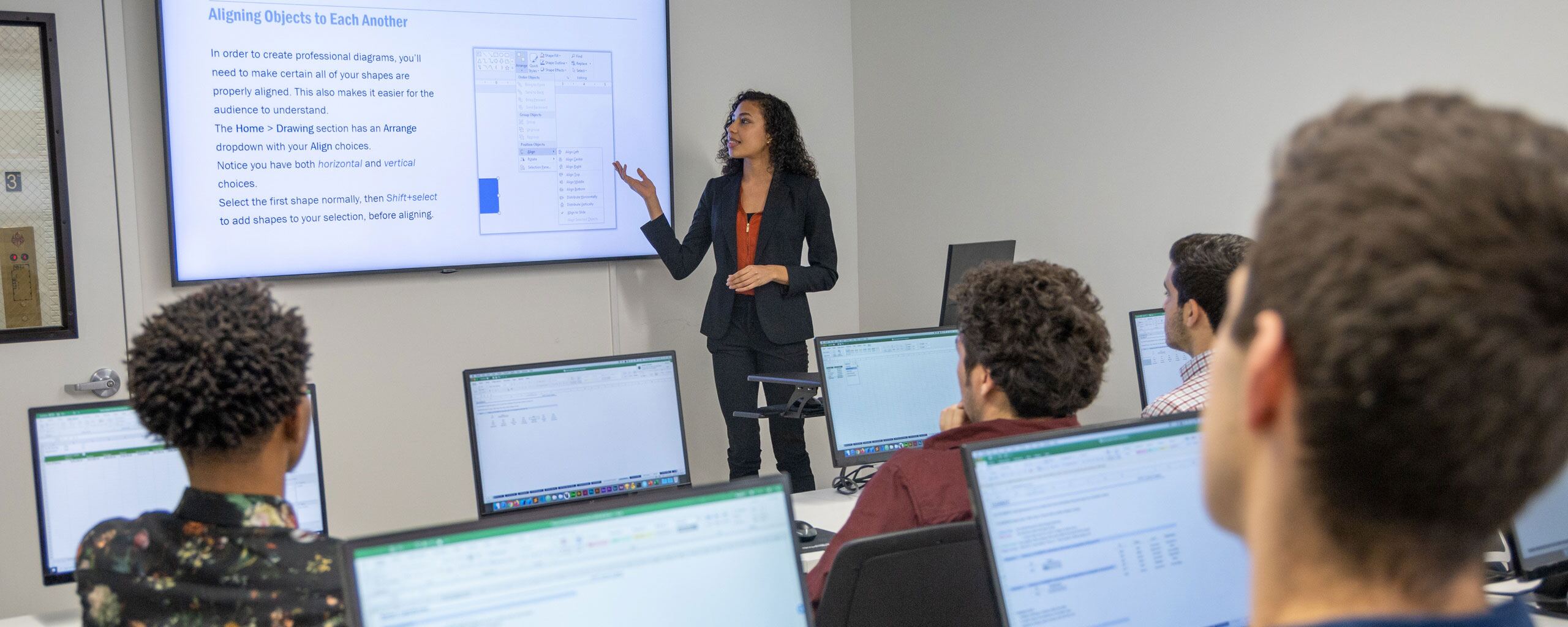
Learn More About IT Classes in Baltimore
The field of information technology (commonly referred to as IT) involves working with computer systems, hardware, software, and networks that support the processing, storage, and distribution of data. IT also includes networking infrastructure such as servers and routers, along with applications that enable communication across internal networks and the internet.
The term “information technology” was first introduced in a 1958 Harvard Business Review publication, which categorized IT into three primary areas: techniques for processing data, the use of mathematical and statistical models to support decision-making, and the simulation of higher-order thinking through computer programs. Today, businesses across nearly every industry maintain dedicated IT departments staffed by professionals who manage these responsibilities and ensure systems operate securely and efficiently.
Data processing plays a critical role in many business functions, including product development, marketing and market research, sales and invoicing, customer relationship management, accounting, human resources, payroll, and regulatory compliance. As organizations increasingly rely on digital systems and cloud-based tools, IT has become essential to day-to-day operations, making it a practical and future-focused career path.
Why Learn IT?
Learning IT can open the door to a wide range of career opportunities. According to the U.S. Bureau of Labor Statistics, hundreds of thousands of IT job openings are expected each year through the early 2030s, driven by ongoing demand for technology professionals across industries. Many IT roles also offer salaries well above the national median, reflecting the specialized skills and responsibilities involved.
Some professionals choose to pursue IT certifications to strengthen their credentials. Certifications act as recognized benchmarks within the field, demonstrating technical proficiency, motivation, and commitment to professional development. Preparing for certification exams often requires an investment of time and money, which can further signal dedication to employers.
Ongoing certification requirements are common in IT, particularly in areas such as cybersecurity, networking, and cloud computing. For professionals seeking promotions or expanded responsibilities, certification training can help validate readiness for more advanced roles. In some cases, employers may help cover certification costs, especially when training aligns with organizational needs.
Another advantage of working in IT is flexibility. Many IT professionals can work remotely or in hybrid environments, supporting users and systems through virtual collaboration tools. This flexibility allows professionals to live outside major urban centers while still contributing to organizations based elsewhere, often within the same time zone.
With competitive pay, strong job demand, and flexible work options, IT continues to be an appealing field. The sections below explore the skills you’ll learn in IT training programs and how those skills connect to careers in Baltimore.
What You’ll Learn in an IT Class
Information technology is a broad discipline that requires familiarity with multiple tools and systems. While specific curricula vary by program, most IT courses focus on a core set of technical competencies, along with essential soft skills such as communication, collaboration, and problem-solving.
Security
Security is a foundational element of IT. Entry-level roles often introduce basic security concepts, while more advanced programs dive deeper into protecting systems and data. Topics may include physical, network, and software security; firewall and router configuration; encryption techniques; risk assessment and threat analysis; compliance standards such as HIPAA and PCI-DSS; and introductory ethical hacking concepts.
Programming
Programming skills are valuable for building and maintaining software, automating tasks, and supporting system integrations. Commonly taught languages include Python, JavaScript, PowerShell, Java, and C++. Learning multiple languages helps professionals adapt to different environments and troubleshoot issues more effectively.
Data Analysis
Data analysis skills support troubleshooting, performance monitoring, and informed decision-making. Even a basic understanding of SQL, spreadsheets, and statistics can help IT professionals identify inefficiencies, detect security issues, and improve system performance.
Networks and Systems
Many IT roles focus on maintaining computer systems and networks. Training often covers operating systems such as Windows, Linux, and macOS; hardware and software installation; cloud-based infrastructure; LANs, WANs, VPNs, and system monitoring; and providing technical support to users.
Cloud Computing
Cloud computing is now a core IT skill. Platforms that deliver on-demand computing resources allow organizations to scale efficiently while reducing physical infrastructure costs. IT professionals with cloud experience support the deployment, security, and optimization of these environments across industries.
IT Industries in Baltimore
Baltimore is a major hub for healthcare, education, government, logistics, and research, all of which rely heavily on information technology. The city’s proximity to Washington, D.C., combined with its strong institutional presence, creates steady demand for IT professionals across both public and private sectors.
Healthcare and Life Sciences
Baltimore is nationally recognized for its healthcare and research institutions. Large hospital systems such as Johns Hopkins Hospital and University of Maryland Medical Center, along with biotech companies like Emergent BioSolutions and BD (Becton Dickinson), depend on IT professionals to manage electronic health records, secure patient data, support research platforms, and maintain telehealth systems.
Government and Defense Contracting
Federal agencies and government contractors operate throughout the Baltimore–Washington region. Organizations, including the Social Security Administration, the National Security Agency, and contractors such as Leidos and Northrop Grumman, rely on IT experts for cybersecurity, systems administration, data analytics, and infrastructure modernization.
Education and Research
Universities and research institutions in Baltimore, including Johns Hopkins University, University of Maryland, Baltimore, and the Maryland Institute College of Art (MICA), employ IT staff to support academic systems, research computing, data security, and campus networks.
Logistics and Manufacturing
With the Port of Baltimore serving as a major shipping and logistics hub, companies like Maersk, C.H. Robinson, and local manufacturing firms rely on IT professionals to manage supply chain systems, automation, and data tracking.
IT Careers in Baltimore
IT training can lead to a variety of career paths depending on your interests and specialization. One option is becoming a Systems Architect, responsible for designing and maintaining complex computer and network systems while aligning technology solutions with organizational goals. Another common role is Computer and Information Systems Manager, overseeing IT departments and managing infrastructure, budgets, and personnel.
Professionals interested in security may pursue roles such as Cybersecurity Analyst or Cloud Security Engineer, focusing on protecting systems, identifying vulnerabilities, and implementing safeguards for digital infrastructure. These positions are especially relevant in healthcare, government, and defense-related industries common in the Baltimore area.
With strong demand and salaries that typically exceed national averages, IT careers in Baltimore offer long-term growth potential across multiple sectors. The average salary for a Baltimore Systems Architect is $135,000, and for a Cybersecurity Analyst it is $104,000. A Baltimore Cloud Engineer earns about $130,000 yearly.
Should You Pursue a Certificate or Certification?
While the terms sound similar, certificates and certifications serve different purposes. A certification is a professional credential earned by passing an exam administered by a third-party organization. Certifications validate expertise in specific technologies or methodologies and are often required for advancement in IT roles.
A certificate, by contrast, is awarded after completing a training program and is commonly used for skill-building or career transitions. Certificate programs are typically noncredit and focus on practical, job-ready skills rather than academic degrees.
If you’re new to IT or changing careers, a certificate program may provide a strong foundation. If you’re already working in the field and aiming for advancement, a certification may carry more weight with employers. Both options require an investment of time and resources, so it’s important to consider your goals, budget, and schedule.
IT Classes in Baltimore
Baltimore’s strong presence in healthcare, government, and research makes it an excellent place to study information technology. Many training programs are available in live online and in-person formats, allowing students to build practical skills while preparing for industry-recognized credentials.
For those interested in software development, Noble Desktop’s Software Engineering Certificate provides comprehensive training in front- and back-end technologies, including HTML, CSS, JavaScript, React, Python, and Django. The program emphasizes hands-on projects and mentoring to help students build real-world experience.
Students interested in data-focused roles may consider a Python for Data Science Bootcamp, which covers Python fundamentals, data analysis libraries, and automation techniques. SQL training is also widely available for those looking to work with databases and analytics systems commonly used across industries.
Corporate IT Training in Baltimore
Organizations across Baltimore and the surrounding region benefit from teams with strong IT skills. Noble Desktop offers corporate IT training for businesses in Baltimore, available onsite or in a live online format. Training programs can be customized to align with your organization’s technology stack, goals, and workforce needs. To learn more about corporate training options, contact corporate@nobledesktop.com to schedule a free consultation.
Learn From Noble Desktop’s Experienced IT Instructors in Baltimore
The professional community in Baltimore offers numerous opportunities for individuals interested in exploring fields such as technology, business, design, and data. There’s a strong base of healthcare, biotech, education, and logistics careers that make learning these skills even more worthwhile. Major employers like Johns Hopkins University, Under Armour, T. Rowe Price, and the University of Maryland BioPark are always looking for experienced professionals in a variety of positions and specialties.
Noble’s partner school, Graduate School USA, has facilities located at 600 Maryland Avenue SW, Washington, D.C. 20024, near L’Enfant Plaza in the heart of the city. The building is both professional and inviting, featuring classrooms and training spaces designed for hands-on learning and collaborative workshops. The facility is accessible via various forms of public transportation, including the Metro and buses, making it convenient for students and professionals to travel from D.C. and beyond. Specifically, those traveling from Baltimore will take the MARC Train from Baltimore’s Penn Station to Union Station in Washington, D.C. From there, you’ll transfer to the Metro and ride to L’Enfant Plaza, which is just a short, brisk walk to the building. Fast and reliable transit makes it simple to attend classes in the nation’s capital and navigate the city with ease.
IT skills are essential for supporting systems, networks, and security across Baltimore’s healthcare, government, and business organizations. Students at Noble Desktop can learn core technical concepts from instructors who demonstrate how these technologies are managed in real-world environments. With Noble Desktop’s network of experienced IT instructors, Baltimore professionals can get hands-on training from seasoned professionals that will help them get their foot in the door much more quickly.
Clarissa J. Corbin
Clarissa J. Corbin has built a reputation as one of Baltimore’s most accomplished corporate educators and project management professionals. With more than 25 years of experience, she leads Projections Training Solutions, partnering with federal agencies and nonprofits to deliver programs in leadership, project management, Microsoft Office, and business analysis. Clarissa’s influence extends beyond Maryland, as she has trained over 10,000 professionals across North America, Asia, and the Caribbean. These clients include NASA, Microsoft, the DoD, and Citibank.
Michele Proctor
Michele is a business strategist and HR leader with over 25 years of experience helping organizations and people thrive. She has worked across the public, private, federal, and higher education sectors, specializing in leadership development, organizational growth, and performance management. She has also worked as a career coach, helping others achieve their goals. She has held senior roles at Howard University and the Air Line Pilots Association, where she led major HR initiatives. To add on, she founded her own consulting firm, Renquest & Associates Inc. In her educational career, Michele held adjunct faculty positions, received numerous awards, and prides herself on helping people find their strengths in the workplace. She is passionate about fostering a successful, strong workplace to help employees succeed and the organization run smoothly.