Learn More About AutoCAD Classes & Certifications in Washington, D.C.
Developed by Autodesk, AutoCAD is the most widely used computer-aided design (CAD) software worldwide. It is used to create architectural, construction, and engineering blueprints, schematics, and models. Released by Autodesk in 1982, AutoCAD makes 2D and 3D design more efficient by letting you draw and edit digital designs more quickly and easily than you could by hand. The files can also be effortlessly saved and stored in the cloud, so you can access them anywhere at any time.
Before the dawn of computers, a Designer would have to revise designs manually. You would have to create an entirely new draft or edit the existing draft, which could be messy and challenging to interpret. With AutoCAD, you can change and manipulate designs, as well as create a reusable block library to replicate design parts. Saved files can be reused later, making the design process faster than if done by hand. Drawing by hand also limits how small a design you can create, but AutoCAD allows you to design down to fractional precision. This allows for a more accurate design in all dimensions.
AutoCAD can be downloaded from Autodesk’s website, where you can purchase a subscription to keep up with the latest software versions. There are many ways to learn AutoCAD, as there are a variety of self-paced, virtual, and in-person classes and tutorials available. While there are other comparable CAD programs on the market, AutoCAD is known as the industry-standard, and it is a valuable skill to add to your resume.
If you want to know more about what AutoCAD is, what you can do with it, and why you should learn it, you can check out Noble Desktop’s AutoCAD page and read more below.
What Can You Do with AutoCAD Training?
With this industry-standard software for CAD and drafting, you can create, edit, and collaborate across desktop, web, and mobile devices. By using AutoCAD, you can produce precise 2D and 3D drawings and models, electrical diagrams, construction drawings, interior designs, and more.
AutoCAD is a versatile software featuring many industry-specific tools and features, making the design process more accessible through its many automation and customization tools. Because of this, it is a popular and vital tool for professionals in many industries, including interior design, project management, machining, manufacturing, architectural design, and engineering. The software allows team members to share and collaborate seamlessly on projects across their devices from anywhere.
For example, you could leverage AutoCAD to create a detailed floor plan for a client’s new house, measuring and placing doors and windows accurately. Plus, AutoCAD’s 3D tools can turn the 2D plan into a 3D model, allowing clients to virtually walk through the house before it’s built.
AutoCAD can also be used to design engineering projects, like a bridge. The software allows you to draw the bridge’s support structures and calculate their load-bearing capacities to determine how much weight each part can handle, ensuring the bridge is safe for cars and people.
If you’re designing a new electronic device, AutoCAD can come in handy. The 3D modeling features can visualize how the device will look from different angles, helping to refine the design before production.
AutoCAD can also be used in the entertainment industry to design sets, stage layouts, and lighting. It helps set designers create detailed and functional sets for theaters, concerts, and film productions. Lighting designers can simulate and test out lighting effects to achieve the desired effects.
As you can see, the applications for AutoCAD are vast, and its usefulness continues to increase as technologies and industries evolve. Becoming certified in AutoCAD can make you more marketable in a variety of fields and help you create a fulfilling and successful career.
What Will I Learn in an AutoCAD Class?
AutoCAD is a multifaceted tool, so it comes as no surprise that there’s much to learn in an AutoCAD course. Below is a brief list of the top general skills you’ll master as an AutoCAD student, including both hard and soft skills. All of these will serve you well when applying, interviewing, and working in an AutoCAD role.
Interpersonal & Communication Skills
Expert communication skills are a must-have for AutoCAD professionals. You will need to communicate effectively with stakeholders to understand project requirements, manage expectations, and meet deadlines. Employers will prefer candidates who possess exceptional interpersonal and communication skills to ensure smooth and efficient project delivery as well as positive relationships with team members and stakeholders. Skills like active listening, professionalism, courtesy, flexibility and adaptability, and the ability to work collaboratively with team members are all needed to succeed.
Ability to Interpret Technical Drawings & Specifications
Proficiency in reading and interpreting technical drawings, such as floor plans, elevations, and sections, will also be essential for AutoCAD professionals. Familiarity with industry-standard symbols, conventions, and abbreviations used in technical drawings, as well as a keen attention to detail, are also helpful skills to have. Understanding technical specifications, including materials, finishes, and dimensions, falls under this umbrella of skills as well.
Advanced 3D Modeling & Drafting Skills
Advanced 3D modeling and drafting skills will help you create detailed designs, minimizing the need for revisions. Proficiency in these skills while using AutoCAD or other relevant software, as well as knowledge of advanced modeling techniques like parametric modeling and surface modeling, will all be extremely useful. If you can create complex assemblies and parts in 3D and understand 3D printing and prototyping, you’ll be a highly desirable candidate at any company.
Analytical & Technical Problem Solving Skills
The following skills are vital to ensuring that designs are accurate, functional, and meet the client’s needs.
- Experience in troubleshooting and resolving technical problems
- Strong mathematical and spatial reasoning skills
- Proficiency with analysis tools and software
- Ability to identify and address potential design issues
- Strong attention to detail to ensure accurate designs
Attention to Detail & Time Management
Proven ability to work efficiently and effectively while paying close attention to detail will serve you well in any job, but especially as an AutoCAD professional. Having good time management techniques (like prioritization and delegation) and experience working with strict deadlines while producing accurate, high-quality work will be of great value. Of course, strong organizational skills will help you to manage multiple projects and tasks simultaneously, allowing you to deliver projects on time and error-free.
How Hard Is It to Learn AutoCAD?
According to the Home Design Institute of Paris, the AutoCAD exam is considered quite difficult by prospective test-takers. A comprehensive certification exam covers a wide range of topics related to computer-aided design, drafting, and engineering. The test consists of multiple-choice questions and is intended to measure the applicant’s ability to understand and apply AutoCAD principles.
To pass the AutoCAD certification exam, you’ll need a good understanding of the software and its functions. It’s best if you’ve mastered the basic commands such as zoom, pan, rotate, scale, and edit. Additionally, applicants should be familiar with plotting and plotting operations; be able to create and modify objects; know how to create dimensioning, annotations, and labels; and understand the principles of AutoCAD layer management.
While the exam may be challenging and learning the software can take substantial time, becoming certified in AutoCAD is an achievable goal. The key to success is understanding the fundamentals of AutoCAD, being willing to practice with the software, studying text material extensively, and taking part in AutoCAD coursework or tutorials.
What Are the Most Challenging Parts of Learning AutoCAD?
Several things can be challenging about learning AutoCAD, first and foremost being whether you have any previous computer-aided design (CAD) experience. AutoCAD may seem complicated and unfamiliar if you lack experience with similar software like SketchUp and MicroStation.
Additionally, the multitude of commands and options can seem overwhelming and take some time to master. AutoCAD is a detailed program that can be used in various ways, containing many parts. The good news is that you don’t need to master it all at once; learn-as-you-go can easily be implemented with AutoCAD.
While learning new software always comes with certain challenges, anyone can become an AutoCAD expert with the right determination, passion, and willingness to learn.
How Long Does It Take to Learn AutoCAD?
There are several factors to consider when estimating how much time it will take to get certified. The length of the course, your hours of first-hand experience, and the length of the certification exam will all impact how quickly you can become AutoCAD certified.
The length of AutoCAD courses can vary widely, typically lasting anywhere from a few months to a year. These in-depth courses let you work directly with AutoCAD software to earn the technical skills needed to work with it professionally. Additionally, you’ll be able to create a portfolio of work to prove your competency to potential employers.
According to Autodesk, it’s recommended that you have 1200 hours of real-world AutoCAD software experience, but the minimum required is 400. They also recommend having a general understanding of the following topics:
- Drawing and organizing objects
- Drawing with accuracy
- Advanced editing functions
- Advanced layouts, printing, and alternative outputs
- Annotation techniques
- Reusable content and drawing management
Finally, it’s important to consider the time it will take to study and then take the test. The AutoCAD exam consists of 45-60 questions and typically takes around 120 minutes to complete. It can be taken online or in person at a Pearson VUE Testing Center near you. Once your exam results have been calculated and you pass, you will be emailed a digital badge that showcases your skills and validates your abilities with potential employers in your resume and on professional networking sites.
Should I Learn AutoCAD in Person or Online?
There are many factors to consider when answering this question. The first factor is what learning environment is best suited for you. Do you excel in a collaborative environment where you can interact with peers and receive instant feedback from your instructor? Or, do you prefer a more solitary learning environment, perhaps one where you can learn at your own speed?
You’ll also want to decide how much time you can commit to your education and what level of flexibility your schedule demands. Are you looking to immerse yourself in an intensive program? Do you work full-time and require your classes to be scheduled for evening and weekend hours?
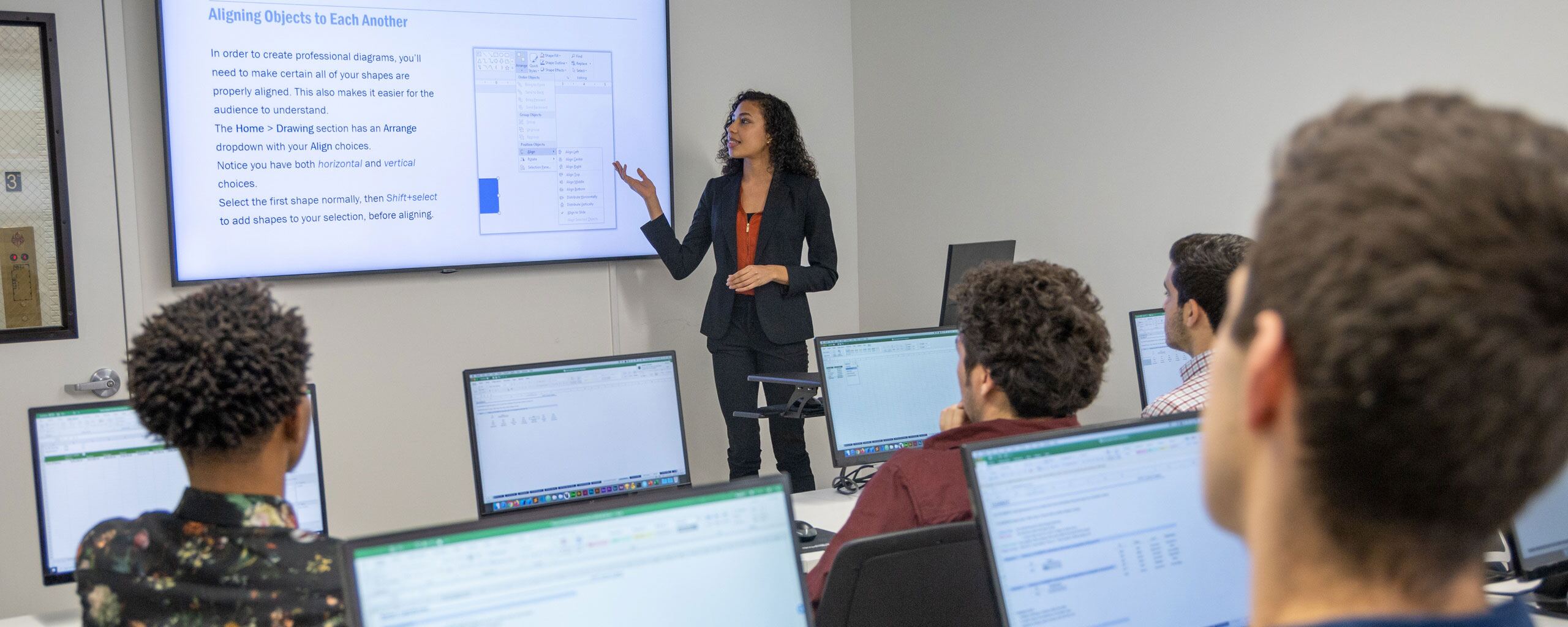
In-person training offers face-to-face interaction with both your fellow students and expert instructors. This collaborative environment is available for both full-time and part-time classes and provides structure and accountability, two things that can help you succeed. Online courses may lack in-person interaction, but make up for it with increased flexibility. Live virtual classes still offer instant feedback from your instructor and interactions with other students, while on-demand virtual courses allow for the most flexibility since you can decide where and when you learn.
The good news is that, no matter which version you attend, you can obtain a quality AutoCAD education with a top-notch curriculum and expert instructors.
What Should I Learn Alongside AutoCAD?
Learning AutoCAD is a great step towards becoming the Architect or engineer of your dreams, but it’s also helpful to be knowledgeable in additional design software. Other design applications that could be beneficial are Adobe Illustrator, Adobe XD, and Adobe InDesign. Additionally, Adobe Substance 3D and AutoCAD work together, so mastering this Adobe program can be beneficial as well. Many jobs that require AutoCAD skills may also expect proficiency in additional design software. Plus, regardless of where your career will take you, gaining additional skills will always help you stand out.
Washington, D.C. Industries That Use AutoCAD
Thanks to its versatility, you’ll find AutoCAD used to design products and projects in countless sectors. These industries will have unique requirements and expectations for AutoCAD professionals, so it’s important to take that into account when applying to jobs in various fields. If you already know what industry you’d like to enter, you can then choose an AutoCAD course that caters to that field. Don’t worry if you haven’t chosen an industry; several of Washington D.C.’s top industries are outlined below.
Technology and Innovation
Washington, D.C. is the #3 tech city in America and ranks in the top 5 for startup success. It’s also the #1 city for women in tech and is home to one of the most diverse tech-related workforces in the nation. With tremendous assets and opportunities for startups looking to solve the world’s challenges in innovative ways, the tech industry is alive and well, and in need of top-quality AutoCAD experts.
Hospitality and Tourism
The hospitality and tourism sector in D.C. includes roughly 130 hotels with 31,000+ rooms, 2,000+ restaurants, and 45 performing arts venues with more than 27,000 seats. It’s also home to the corporate headquarters of Marriott, Hilton, and Host Hotels, providing access to an influential customer base.
International Business
With approximately 180 resident embassies and respected global economic and policy organizations, Washington, D.C.’s international business industry is alive and well. The World Bank, the International Monetary Fund, the Organization of American States, the Inter-American Development Bank, and the Carnegie Endowment for International Peace consider Washington, DC, a center for critical international conversations about the world economy, global politics, the environment, and peace.
Higher Education
The university system in the D.C. region boasts more than 11 colleges and universities serving as major employers and innovation centers, generating over 30,000 jobs. Plus, the District has one of the most educated populations in the country, with nearly 50 percent of its residents obtaining a bachelor’s degree or higher. The economic impact of the universities in the area is close to $2 billion, and, as a sector, higher education is the largest employer and one of the largest sectors in terms of businesses and governments around the world.
AutoCAD Job Titles and Salaries in Washington, D.C.
Often referred to as a CAD Drafter, an expert in AutoCAD could work in a variety of industries under numerous job titles. AutoCAD is instrumental in designing products and projects in a wide range of industries, including aerospace, healthcare, and energy, so you could find fulfilling work in any of these fields with an AutoCAD certification. And, with companies like Disney, Hyundai Motor Group, and Blox leveraging AutoCAD, you could even end up working for a well-known and established employer.
Mechanical Engineer
Mechanical Engineers design, develop, build, and test mechanical and thermal sensors and devices. AutoCAD is often used by Mechanical Engineers to create manufacturing processes and design motor parts, robots, and other innovative objects. According to the U.S. Bureau of Labor Statistics, the median salary for a Mechanical Engineer is $96,000. With job opportunities projected to grow 10 percent from 2022 to 2032, much faster than the average for all occupations, it shouldn’t be too difficult to find a Mechanical Engineering role.
Electrical Engineer
Electrical Engineers are inventors, designers, and builders who understand how to manipulate currents and voltages in creative ways that advance technology. Like all areas of engineering, this academic discipline is a hands-on field that involves making and improving practical objects. They use AutoCAD to map out electrical systems, while an Electrical Engineer makes around $103,000.
Civil Engineer
Civil Engineers might use AutoCAD to help design bridges and roads, streamlining these developments for both the private and public sectors. On average, a Civil Engineer makes $89,000, with the potential to earn much more in a senior role.
AutoCAD Designer or Drafter
If you lack the education or experience for these higher-level roles, you could become an AutoCAD Designer and make approximately $66,000 starting out. Similarly, an AutoCAD Drafter can make around $61,000, with the potential to earn upwards of $85,000 with a few years of experience.
AutoCAD Classes from Noble Desktop
There are a few AutoCAD classes available in the D.C. metro area, and several additional options are offered virtually.
Noble Desktop’s AutoCAD Level I course for beginners provides an overview of all the basics, like printing and plotting layouts and sheets, working between model and paper space, and scaling drawings through viewports. You’ll also learn how to insert blocks, make text, create dimensional drawings, and work with layers and templates. Because this is an introductory course that provides you with a strong foundation of basic AutoCAD skills, there are no required prerequisites.
AutoCAD Level II builds upon the fundamentals and teaches you how to create more technical and advanced projects. You’ll master creating templates with defined layouts by setting units, drawing limits, and using scales. You’ll also learn how to use the interface to complete advanced layer and block techniques. Consisting of 12 hours of hands-on instruction and live project-based training from industry experts, you’ll be a confident AutoCAD Designer by the end of Level II.
Noble Desktop’s AutoCAD Bootcamp combines all the topics from Levels I and II for a comprehensive overview of everything you’ll need to master the software. In addition, you’ll learn how to create drawings that you can use to build real-world objects and get valuable feedback from instructors in real-time, whether you participate virtually or in person. Composed of 30 hours of hands-on instruction, you also get one free retake within a year and a verified digital certificate of completion.
Note for Level I, Level II, and the Bootcamp: Each of these courses is designed for PC users, and Noble Desktop’s in-person classes are PC-only. Mac users may attend online, but the Mac AutoCAD graphic interface is different from the PC version, which is what the instructor will use and what the class will focus on.
Noble Desktop also offers AutoCAD classes in self-paced formats: The AutoCAD Course Online, the AutoCAD Certification course, and the AutoCAD & Civil 3D Certification course.
AutoCAD Corporate Training
If you’re looking to offer in-person or online training to your office or team, Noble Desktop can help. They offer a variety of corporate training programs, including in AutoCAD. You can order vouchers in bulk at a discount, choose which courses are available to employees, and even let your employees choose their own schedule. Plus, you can choose to have your training hosted at a location of your choosing, live online, or at Noble Desktop’s Manhattan office.
With a top-notch customizable curriculum and instructors who are experts in their industries, Noble Desktop’s corporate training is designed to cater to your business or organization’s needs. For more information or to schedule a free consultation, you can reach out to Noble Desktop at corporate@nobledesktop.com.
Learn From Noble Desktop’s Experienced AutoCAD Instructors in Washington, D.C.
As the nation’s capital, Washington, D.C., is a hub for government, public service, and major organizations, which means there’s ample opportunity for professional development. If you’re looking to expand your knowledge in the field of tech, data, business, or design, you can explore training options available to both individuals and federal professionals. Classes are right in the heart of the city, offering knowledgeable instructors with decades of combined training and a wide range of specializations. From their real-world experience in the field, these instructors provide valuable insights that help students get comfortable while learning the material. Not to mention, the skills they develop in the classroom are practical and transferable, meaning students can put their newfound knowledge right to work.
Training with Noble Desktop’s team is easy with the modern facilities located at 600 Maryland Avenue SW, Washington, D.C., 20024. It’s mere steps away from L’Enfant Plaza and offers an array of benefits, like a professional yet welcoming environment and a modern workspace. Getting there from anywhere in D.C. is straightforward, whether by Metro, bus, or car. L’Enfant Plaza is served by multiple Metro lines, and there are several bus routes that stop nearby. Those driving can also access parking garages that are easily within walking distance.
AutoCAD is essential for drafting, planning, and design work across D.C.’s architecture, engineering, and federal sectors. Students at Noble Desktop will get an opportunity to learn precise drawing skills and CAD workflows from instructors familiar with real AEC project requirements. Learning at this school also offers a wide range of professional development opportunities, with classes led by expert instructors who can help you acquire skills that get you ready for the real world.
Brian Simms
Brian is an educator and training leader passionate about helping professionals grow in fields like project management and AI. He designs adaptive learning programs that combine instructor-led sessions, live online experiences, and self-paced study, making training practical and within reach for anyone. Brian’s work also centers heavily around AI integration, particularly in training situations to show organizations how easy it can be applied to the workplace, showing ways to tackle real-world problems, enhance leadership, streamline projects, and support better decision-making. Beyond teaching, he has also developed curricula and led training on a massive scale. Brian’s blend of talents and interests makes him well-positioned to train others and help them navigate the complexities of the subject matter.
Clarissa Corbin
With more than 25 years of experience, Clarissa is a seasoned corporate trainer, Project Manager, and Business Consultant and has helped professionals and organizations alike achieve tangible results around the world. Her work has taken her to amazing places around the world, from China to Africa, training over 10,000 participants in leadership, project management, business analysis, and emerging technologies. Clarissa has worked with teams at NASA, Microsoft, Citibank, and FEMA, just to name a few, and is known for designing interactive yet practical sessions where her listeners can apply their skills immediately. At Graduate School USA, she played a pivotal role and contributed to numerous programs, including the Managing for Results course. She’s a quality instructor, focusing on subjects like project management, AI, and even Adobe, and has a heavy commitment to professionalism, innovation, and student success.
Michelle Proctor
Michele’s professional record in Human Resources, organizational development, and leadership training has been acquired over 25 years in the field. She is a Business Strategist and HR innovator who has helped public, private, federal, and higher education organizations on their path to success. In particular, Michele excels in organizational assessment, project and performance management, workforce development, change management, conflict resolution, and AI initiatives. She prides herself on guiding individuals to leverage their strengths while fulfilling their professional lives. Her consulting work includes leading the DC Courts HR Division’s Five-Year Strategic Plan and Workforce Development Program, “Fulfilling Our Future.” She’s also held senior executive positions at Howard University, the Air Line Pilots Association, and Executive Transitions International. She’s currently working as an adjunct faculty at Graduate School USA and Anne Arundel Community College.
Alan Zucker
Alan Zucker brings real-world expertise from both the federal government and Fortune 100 companies to the classroom. With more than 25 years of professional work in project management, he makes for an ideal instructor. He has managed the project execution organization of 175 professionals, led high-visibility strategic initiatives, and delivered thousands of successful projects. His education began at George Washington University, where he earned his Bachelor’s, before progressing to earn a Master's in Economics from the University of Maryland. Moreover, he holds a wide variety of certifications, such as the Project Management Professional Certification (PMP), PMI-ACP, Disciplined Agile Coach, SAFe Program Consultant, Certified Scrum Professional, and Agile Leadership Academy Trainer. Alan is an active member of the project management community, having served as a keynote speaker, frequent industry commentator, and author of nearly 150 articles on project management.
Tashea Coates
Tashea is a Human Resources Executive and Federal Consultant, holding over 23 years of experience across multiple federal agencies, including the Departments of Homeland Security, Justice, Treasury, State, and Health and Human Services. Known for her ability to strategize and take the lead, Tahsea has transformed HR policies to align with mission strategies and outcomes, influencing government-wide procedures such as onboarding and pay equity. Tashea is a staunch advocate for ethical leadership, inclusivity, and organizational success. In addition, she prides herself on her authenticity and purpose-driven spirit, which translates into her work as an educator as well. In addition to teaching subjects like AI. She’s an author and entrepreneur, and is always looking for ways to help organizations and individuals alike.
Charles Byrd
With a strong foundation in federal human resources management and legal counseling, Charles is a highly knowledgeable Employee and Labor Relations Consultant in Washington, D.C. He began his education at Loyola University, earning his B.A. in Business Administration and Political Science, before graduating from the University of Baltimore School of Law. Throughout his career, Charles has guided agencies through complex HR and labor-related challenges, managed HR programs, and represented organizations in legal proceedings. He has also designed and delivered specialized training in human resources, project management, and marketing. Charles’ professional background has led to numerous accolades and awards, showcasing his impact in the field.
David E. McCullin
Dr. David E. McCullin, better known as Dr. Mac, specializes in strategic communication, homeland security, data analytics, and accurate decision-making. Prior to his work at Graduate School USA, Dr. Mac obtained his Bachelor’s in Engineering, his Master’s in National Security and Strategic Studies, and a Doctorate in Management of Complex Adaptive Systems. He served 24 years in the U.S. Army, including 13 in Special Operations. He later worked at the Department of Homeland Security as an Intelligence and Infrastructure Security Analyst for nearly a decade. Through his education and solid professional career, he has been able to teach students a variety of important skills and has also developed innovative learning tools and games that help improve decision-making and analytical thinking skills.
Natalya Bah
As a part-time instructor at Graduate School USA for over 15 years, Natalya’s expertise cannot go unnoticed. She’s an educator and has developed curricula for the school, including the Change Management Workshops and several project management courses. Not to mention, she’s also served as a learning coach, facilitator, and instructor for government leadership programs and has developed the Define and Achieve Your Goals Process. Natalya earned her Master’s in Project Management and her Project Management Professional (PMP) Certification, making her a well-qualified and effective educator, project manager, coach, and consultant.
Alan McCain
Alan is a retired combat veteran of the U.S. Air Force and Navy with over 30 years of experience in federal and commercial budgeting, auditing, programming, operations, supply chain management, and IT acquisitions. He holds an MBA from George Washington University and a Teaching Certification from Harvard’s Bok Center for Teaching and Learning. Throughout his career across federal, state, and local government agencies, Alan has worked for numerous departments, such as the Department of State and Defense, as well as the Office of the Mayor of D.C. Alan is also an accomplished consultant and business strategist, having aided in the development of organizational projects at Lockheed Martin and PwC, to name a few. His background and lengthy career make him an ideal instructor for those looking to learn more about finance, accounting, and project management.
Derk Mattocks
As a skilled instructor and business leader, Derk Mattocks possesses the skills and career experience to bolster his credibility. He gained his B.S. in Organization Management from Nyack College and his Master’s in Leadership and Military Installation Management, as well as an MBA in Financial Management and Analysis from the University of Maryland. He is a licensed Certified Advanced Professional Business Coach and trained mediator, with the certification to facilitate the “Five Practices of Leadership” workshops. Derk has also served as a Senior Advisor and Instructor for the U.S. Army. Overall, he has the credentials to serve as an accomplished and well-versed instructor, often covering topics related to project management and marketing.
Melanie Dooley
Melanie is a federal acquisition and contracting expert with over 30 years of professional experience in Washington, D.C., spanning both government and education sectors. She has served as the Vice President of Acquisition Policy at SAIC and as the Managing Editor of the Federal Contracts Report at Bloomberg BNA. She’s currently an instructor at Graduate School USA, often teaching classes related to the marketing realm. She’s a Certified Professional Contracts Manager (CPCM) and a Fellow of the National Contract Management Association, positioning her as a person with incredible leadership skills and knowledge of her field. She earned her MBA from Georgetown University and is known as a clear, trusted instructor who consistently challenges students to take their skills to the next level.